Shoulder bags
For a MIRUM plant-based vegan leather shoulder bag, review strap attachment, top-edge construction, closure and the areas that bend during use.
Use custom shoulder bag references to define the silhouette and carrying requirements.


Veggance / Material selection & bag development
Exploring MIRUM bags for your next collection? Start with the material article, the silhouette and the details your product needs to perform.
Share your design direction with Veggance. We review material sourcing, construction and development requirements before confirming the next step for your project.

02 / Understand the material
Understand the material identity before comparing finishes, prices or suppliers.
MIRUM® is a plant-based, plastic-free leather alternative developed by Natural Fiber Welding (NFW). The name refers to a specific material platform, rather than every material sold as vegan leather.
NFW describes ingredients including natural rubber, plant oils, plant and mineral pigments, a plant-based curative and a natural fabric backer. Review the composition of the selected article instead of assuming that every finish has the same specification.
Compare it with other handbag material options around the structure, appearance and sourcing requirements of your collection.
Veggance works on finished-bag development. A MIRUM leather supplier and a handbag manufacturer handle different parts of the project: material identity and availability need to be established before construction and sampling can be confirmed.
When a brief uses the phrase “MIRUM fabric,” ask for the article and backing. Those details are more useful than the name alone.
You may also encounter “MIRUM Leder” in German-language briefs. Confirm the same material article, composition and supplier documentation.
03 / Choose the article
Specify the material article as carefully as the bag itself.
| Selection point | What to specify | Why it matters |
|---|---|---|
| Texture & finish | Article reference and approved physical swatch. Epsom, Dollaro, Silvia and Espresso appear in NFW’s published texture catalog. | Confirm the surface grain, sheen and feel against your design. |
| Backing | Cotton canvas, cotton interlock or the backing documented for the selected article. Lyocell jersey is described for certain supplier-listed articles. | Backing affects stretch, fold behavior and sewing response. |
| Thickness & body | Supplier specification, measurement method and sample. | Review seam bulk, edge finishing and the support needed for the silhouette. |
| Color & batch | Color reference, available quantity and approval sample. | Establish what can be sourced now and checked again for a repeat order. |

MIRUM material swatches should be tied to an article reference. Published catalogs help identify options; they do not confirm present stock, color availability or an order schedule.
04 / Review the silhouette
Use the intended silhouette to decide what needs to be tested.
For a MIRUM plant-based vegan leather shoulder bag, review strap attachment, top-edge construction, closure and the areas that bend during use.
Use custom shoulder bag references to define the silhouette and carrying requirements.
A MIRUM handbag brief should specify the intended body, opening width, base support and handle reinforcement. Check low-stretch and minimal-drape requirements against the actual article.
Test whether the selected construction holds the desired shape without excessive seam tension.
A MIRUM wallet places repeated folds, card pockets and slim edges in a small area. Review layer thickness, fold direction and opening behavior in the prototype.
Wallet and small leather goods construction needs its own sample review.
These are development directions for a MIRUM leather bag, rather than an available-product catalog. Material sourcing and a physical sample determine whether a design can proceed.
05 / Compare your options
Choose around your product requirements, then validate the actual material.
| Buyer decision | MIRUM review | Other vegan leather options |
|---|---|---|
| Composition | Request the branded material article and its documentation. | Identify the surface polymer, backing and any plant-derived or recycled content. |
| Look & structure | Approve the texture, body and fold response on a physical swatch. | Compare the exact grade and construction, rather than the broad material name. |
| Manufacturing | Validate seams, edges and logo methods with the selected article. | Review the processes appropriate to the specified coating and backing. |
| Order feasibility | Confirm a sourcing route, sample quantity and bulk requirements. | Confirm grade-specific availability, minimums and delivery conditions. |
| Product claims | Separate the outer material from the lining, adhesive, thread and trims. | Check what each claim covers and which documents support it. |
Broader vegan leather bag options can be considered when your preferred material does not fit the design, budget or sourcing schedule. For custom plastic-free leather alternative bags, assess every component before describing the finished product as plastic-free.
06 / Develop the details
Resolve the small details before committing them to a finished-bag specification.
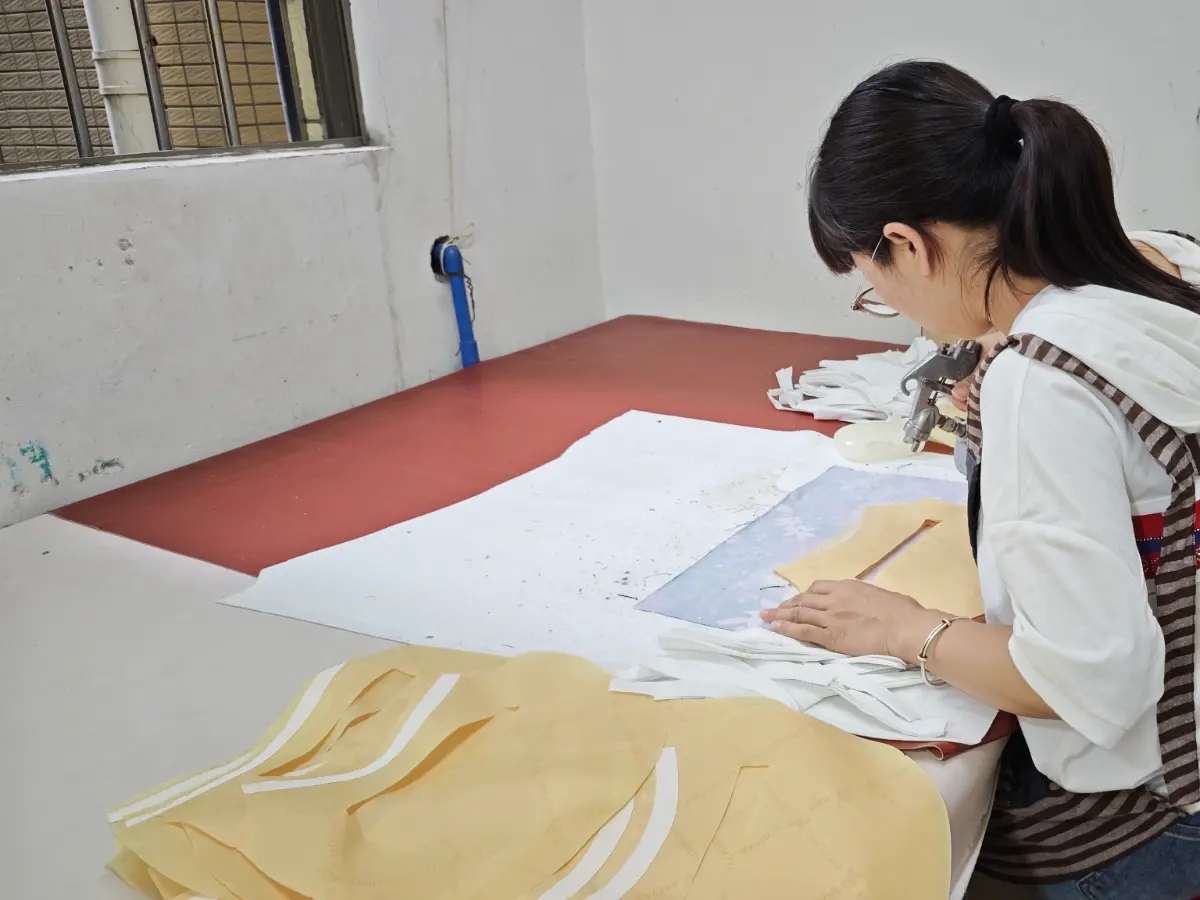
Material and finish customization should follow an approved test piece before it becomes part of the product specification.
07 / Verify the requirements
Connect every quality requirement and product statement to the right evidence.
Ask which article, backing, color and test conditions a report covers. A result for one material configuration should not become a universal rating for the entire range.
Handbag quality control also needs to address load points, strap attachments, closures, repeated folds and the approved construction.
A water-resistant outer material does not establish that a finished bag is waterproof. Consider openings, seams and other components separately.
A “made with MIRUM” description should refer to a documented material in the product. Material documentation, factory certifications and finished-product test reports serve different purposes.
Claims about biodegradation, recyclability or certification need documentation for the specified material and the conditions being described. They should not be inferred from a plant-based or vegan label.
08 / Plan the order
Bring sourcing, development and order conditions into one project review.
Provide a preferred article, swatch or supplier reference. We first clarify the sourcing route and whether material is available for the proposed development.
A public catalog or waitlist is not an order confirmation. Check sample access and a realistic bulk supply route separately.
Sampling and prototyping bring the dimensions, construction, logo, lining and hardware into one reviewable product.
For a MIRUM bag OEM or private label MIRUM handbags brief, identify which details are fixed and which need development.
MIRUM leather price is one input in a finished-bag quotation. Material usage, cutting yield, construction, hardware, branding, packaging and freight also affect cost.
Confirm the raw-material minimum separately from the finished-bag MOQ. Establish material procurement, sampling and production timing for the specific project.
Keep the approved sample, material reference and revision record together. Review bulk materials against the specification and confirm the packing approach.
For a repeat order, check the availability and consistency of the same article before carrying forward an earlier quotation or schedule.
When selecting a MIRUM handbag manufacturer, ask how material identity, prototype approval and repeat-order continuity will be recorded. Production feasibility is confirmed after the material and construction review.
09 / Your project contact
A clear point of contact from the first questions to the agreed next step.

I help brands, importers and retail teams turn a handbag idea into a clear development brief. If MIRUM is on your material shortlist, send me the reference, the bag design and the details that matter to your collection.
I coordinate questions about sourcing, structure, lining, hardware and branding with our team. Before we agree a sampling or production plan, I help identify what still needs to be confirmed.
I also organize sample comments, revisions and approval details so your team has a consistent reference for the next stage.
My work as your handbag project contact is to keep those decisions and the next steps clear.
10 / Your next step
Tell us what you want to create and which material decisions need support.
Dimensions, target cost, destination market, logo artwork and testing requirements help us make the review more specific. You can contact us before the brief is complete.
The first step is a material and project assessment. We confirm what can move forward and which details need further review before quoting or sampling.
 Optimized by Seraphinite Accelerator